I earn a commission when you buy through my links, at no extra cost to you. How that worksAmazon prices as of Nov 25, 4:19 AM ET, subject to change. Details
On this page (10 sections)
The doorbell rings, four players come in, and each one needs a seat, a rack and a card within reach. To host a mahjong party, plan one table for every four players, and give each table one American set with four racks, a mat, a card for each player and a place for drinks that isn't the tiles.
Everything else, the food, the decor, the favors, is the fun part, and it's much easier once the tables are sorted.
What you need for each mahjong table
One table seats four players, and it needs:
- A card table, ideally 36 inches square, the usual folding size. A round dining table works too.
- One American mahjong set, with 152 tiles to play, racks and pushers for four, and dice.
- A mat, so the tiles slide quietly and don't scratch the table.
- A card for each player. The League sells the card, it changes every year, and players who play regularly bring their own.
- Coins or chips, if your table plays for money (how the payouts work).
Before the guests arrive, open each set and count. A set missing a joker or a flower plays wrong all evening, and you'll only notice halfway through a hand.
Mahjong party supplies for one, two or four tables
The count follows the tables, not the guest list. Here's what to have ready, assuming players bring their own cards:
| 1 table (4 players) | 2 tables (8 players) | 4 tables (16 players, or a class) | |
|---|---|---|---|
| Card tables | 1 | 2 | 4 |
| Sets, racks included | 1 | 2 | 4 |
| Mats | 1 | 2 | 4 |
| Card stands | 1 pack of 4 | 2 packs | 4 packs |
| Shufflers | 1 pack of 4 | 2 packs | 4 packs |
| Spare cards for newcomers | 0 or 1 | 1 or 2 | 1 per beginner |
The Soulchen shufflers are worth it as soon as you host more than one table: mixing 152 tiles by hand takes a while, and these thick cards scoop and turn the tiles in a few passes.

If nobody wants real money on the table, the GUSTARIA coins stand in for it: a hundred plastic chips in five colors, enough for one table, so buy a pack per table.

What the host lends and what each player brings
When you host two tables or more, nobody expects you to own everything. A simple split that works for most groups:
- The host provides the tables, the chairs, the light, the food and drinks, and at least one set and mat per table, borrowed from regulars if needed.
- Each player brings her own card, her coins, and, if she has one, her set and mat. Ask ahead who's bringing a set so you know how many tables you can open.
- For a class or a beginners' night, have a card for every new player, or ask them to order one before the evening, plus a printed rules sheet at each seat.
Beginners also go faster when the first game starts from a set-up table, walls built and ready to break (how to set up the tiles).
How many people do you need for a mahjong party?
Four per table is the game. If the numbers don't divide by four, you still have options:
- Five players: the fifth sits out. At the end of each hand, the dealer (East) steps away and the waiting player takes her seat, so everyone rotates. Some tables let the waiting player bet on who will win; that's optional, so agree on it first.
- Three players can play at their own table with a few changes (three-player mahjong).
- Two players can play Siamese mahjong (the two-player game).
Set up the room
- Space between tables. Players need to stand up, reach the food and walk behind chairs without bumping a rack.
- Good light over every table. Players read the tiles across the table all night, and dim party lighting makes a 3 Bam look like an 8 Bam.
- A separate table for food and drinks. Plates on the mat end in greasy tiles and a spilled glass across the card.
- A small surface next to each player for her glass, if you can manage it: a side table, a tray, a stool.
Mahjong party food and snacks
The best mahjong food is eaten with one hand and leaves no grease on the fingers: cheese and crackers, fruit skewers, small sandwiches, nuts, cookies that don't crumble. Save anything saucy or flaky for a break between games, at the food table.
The Aodaer cocktail picks do two jobs at once: they keep fingers off the food, and their beads come in six tile designs, so the platter matches the theme without extra decorating.

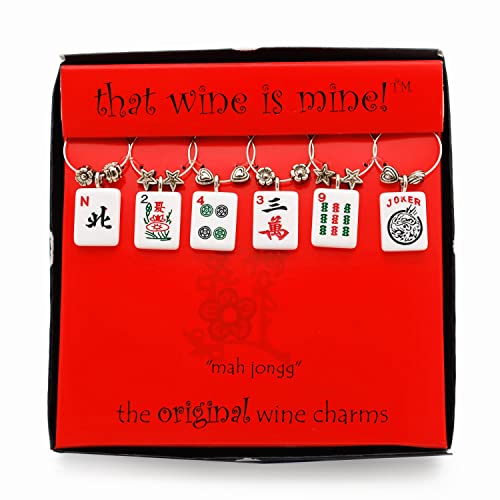
For drinks, wine glasses multiply fast at two tables. The Supreme Housewares wine charms tell them apart, six to a box, with a joker and a flower among them, and they make a good hostess gift if you're the guest.
Mahjong party decorations
If you want the room to look like a mahjong party in one purchase, the wellspar party set covers it: tile-print plates in two sizes, cocktail napkins, cups, forks and straws for 25, tablecloths, a banner that comes already strung, and centerpieces. Keep the tablecloths for the food table, though; the game tables keep their mats.

For a single table of four, that's a lot. A pack of Rosanne Beck napkins printed with mahjong tiles is enough to set the tone next to the drinks.

Mahjong party ideas and themes
- A beginners' night. One experienced player per table, and the Charleston walked through slowly in the first game.
- A birthday party. A banner, cupcakes, and a set or a mahjong gift for the guest of honor.
- A holiday party. In December, a Christmas set on one table makes the theme without any decorating.
- A mini tournament. Count each player's mahjongs over the evening, or her winnings in coins, and give a prize to the top player at each table.
- A weekly mahj night. Same night, same time, and the host rotates through the group, so no one carries the table every week.
The 20-piece prize set covers prizes and party favors for a whole group: twenty acrylic tile keychains, each with its own card and clear bag, so there's one for every guest at four tables.

Before the first deal: agree on the table rules
The one thing to settle before the party, not during it, is how each table plays. Every table has its house rules, and two tables playing different ones means disputes in the middle of a game. Decide, or ask your regulars:
- What you play for: cents, chips, or nothing (the payouts).
- Whether the second Charleston happens. By the League's rules it's optional, and one player saying "stop" after the first left skips it for everyone.
- What happens with a fifth player, sitting out and whether she can bet.
- How long the evening runs, so the last game starts on time.
Write the answers on an index card and leave one on each table. For a party with new players, I'd keep the stakes at chips and let the second Charleston happen: it's slower, but beginners learn more from it.